OCD Treatment and ERP Therapy in Sydney
Why do I keep checking things over and over? Obsessive-Compulsive Disorder (OCD)
Am I a bad person for having these thoughts?
Many people with OCD carry this fear quietly. Unwanted thoughts about harm, contamination, sex, religion, or something terrible happening are common, and having them does not mean you want them or would ever act on them. OCD makes them stick, and the urge to check, wash, or go over things in your head can take over the day. OCD is treatable, and these thoughts are safe to talk about here. We only act to protect someone if there is a serious risk of harm, not because of the thoughts themselves. Our psychologists in Neutral Bay offer OCD treatment in Sydney.
Table of Contents
- Am I a bad person for having these thoughts?
- How ERP therapy works here
- How long does it take for ERP Therapy to help OCD?
- What is OCD?
- The Three Components of OCD
- What does ERP stand for – the roots of Exposure and Response Prevention
- Challenges in OCD Treatment in Sydney
- Other options alongside ERP
- Cognitive Therapy for OCD: Unhelpful thought patterns
- Overview of OCD Treatment
How ERP therapy works here
The main treatment for OCD is exposure and response prevention (ERP), a type of CBT. It is gradual and planned together. You and your psychologist list the situations that set off your OCD, from the least to the most distressing, and you begin with a small step, not the hardest one. You practise facing that situation without doing the compulsion, and you move up only when you are ready. Many people find that substantial gains come within about 15-20 sessions.
How long does it take for ERP Therapy to help OCD?
It usually varies case-by-case, as with most psychological disorders and interventions. However, broadly speaking, substantial gains can be achieved within 15-20 sessions, if the client is motivated to change, the therapeutic alliance between the client and therapist is good, and OCD mostly affects behaviours rather than thoughts.
For children and adolescents and mild to moderate cases, generally 12-20 sessions are needed. For adults with similar presentations, 12-16 sessions.
Contamination fears with OCD typically require more sessions, with both adults and children and adolescents needing more than 20 sessions.
Checking behaviours are generally easier to manage, and people see benefits between 12-16 sessions in mild to moderate cases.
Hoarding, a special type of OCD, tends to be more treatment resistant, with individuals needing at least 24 or more sessions to manage their symptoms.
What is OCD?
Obsessive-compulsive disorder (OCD) is a mental health condition linked to intrusive, obsessive thoughts (thinking repetitively about distressing things) and compulsions (needing to do certain things in a certain way). It often affects work and social life. While OCD comes with a lot of anxiety, since 2013 it is not classified as an anxiety disorder.
The Three Components of OCD
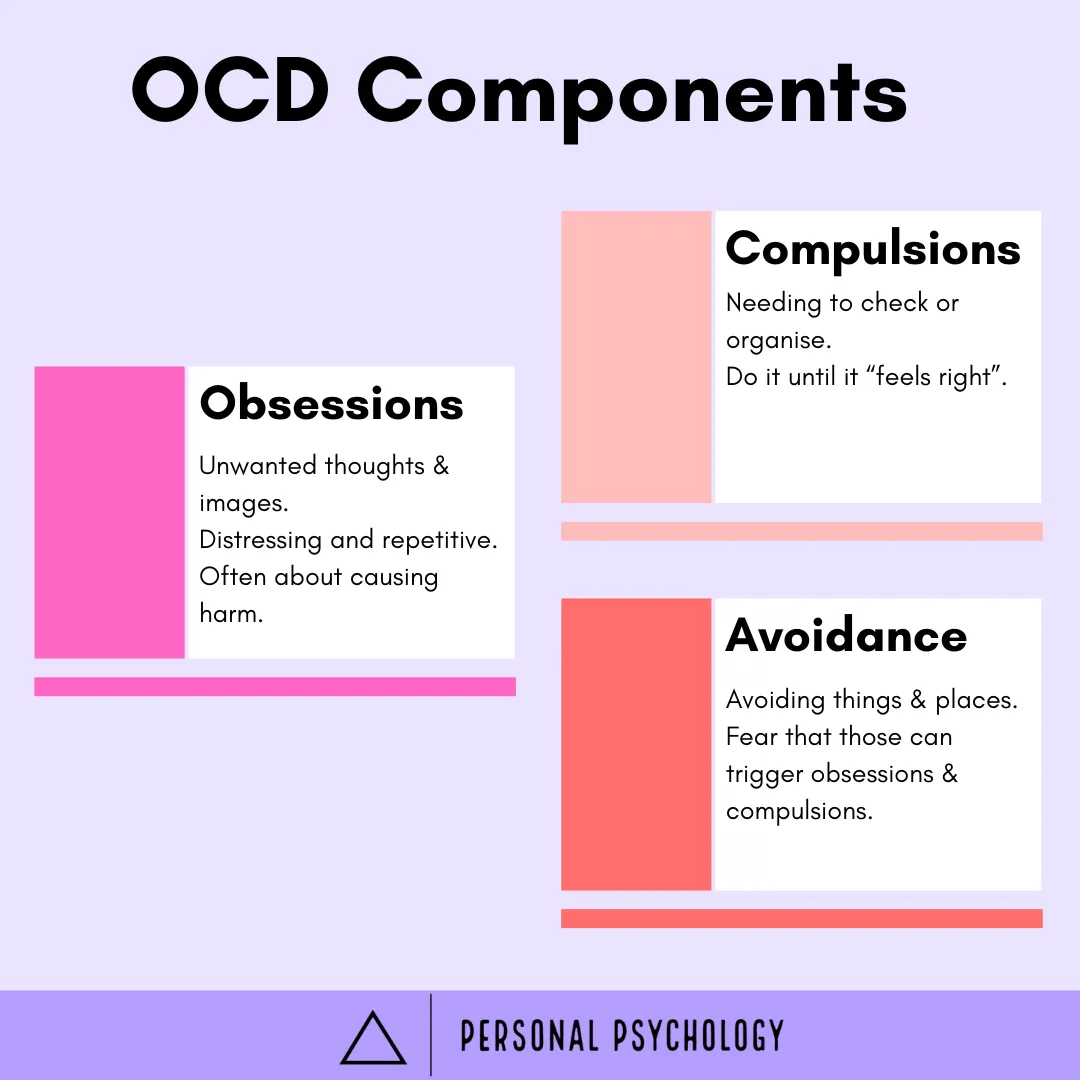
OCD is characterised by three primary components. First, obsessions: intrusive and unwanted thoughts, images, or ideas, often about distressing themes, contamination, or being uncertain about completing certain actions, such as locking the door. The second component involves compulsions, which are specific behavioural actions (doing things), checking things, or covert mental rituals (thinking about things until it feels just right). These are used to neutralise the negative feelings associated with the obsessions. Many people also develop avoidance, such as not going to places or not doing certain things, to prevent the obsessions and compulsions from being set off.
Living with OCD can be a heavy burden for the person and the people around them. Treatment can help people regain more control over their thoughts and actions. Cognitive-behavioural therapy (CBT) and exposure and response prevention (ERP) are the approaches with the most research behind them, and we tailor them to each person. ERP is available for adults and as therapy for teens from age 14.
What does ERP stand for – the roots of Exposure and Response Prevention
CBT therapy has emerged as the most effective psychotherapeutic method for treating OCD. Exposure with response prevention (ERP), a subset of CBT, is the first line treatment for OCD. The core principles of ERP were defined in 1966 (Meyer). While the treatment went through refinements since then to address the diverse presentation of OCD, the core ideas remained the same. ERP is personalised to address the diverse symptoms of OCD, which sometimes include aggressive obsessions, checking compulsions, symmetry obsessions, ordering compulsions, contamination obsessions, cleaning compulsions, and even hoarding.
Other conditions, especially other anxiety disorders and depression, can occur alongside OCD, and these are addressed during therapy as well.
Challenges in OCD Treatment in Sydney
The wide variety of OCD symptoms make it difficult to apply a one-size-fits-all treatment plan. Mental obsessions and intrusive thoughts (rather than just behaviours) often require more therapy sessions, as behaviours are generally easier to change than thoughts. Other symptoms, such as contamination fears, may be harder to treat when they are paired with disgust, which responds differently to exposure than anxiety does.
How does ERP work for OCD?
ERP is a structured treatment that gradually and carefully exposes you to your OCD fears, making the progress neither too easy, nor too hard. The treatment process involves creating an exposure hierarchy of feared objects or situations, ranging from the least anxiety or fear provoking (level 1) to the most distressing (level 10). You are then gradually exposed to items on this hierarchy, typically starting around level 3 or 4, working up to level 10.
Apart from exposure, the treatment also involves response prevention: agreeing to hold off on the compulsive behaviours that would neutralise or ease the anxiety. For example, if you feel you need to check the door again to make sure it is locked, you practise not doing it, even if it feels uncomfortable. If you ‘slip’ after completing a level and give in to the urge, that is not a failure; we repeat the exposure as soon as possible.
Numerous studies have shown the efficacy of ERP for OCD. Therapist-guided exposure in the real world (completing tasks in vivo), together with imagining distressing situations, has shown the most significant symptom reduction. Response prevention works better when complete rather than partial, as in, not giving in at all rather than stopping right before completing the action (not even walking to the door to check the lock). Exposure paired with imagery has also helped reduce low mood in people with OCD.
What helps ERP work
ERP has to strike a balance between activating the fear and not overwhelming you. Going too fast up the exposure hierarchy can make it harder to learn that the fear can be tolerated and that anxiety settles by itself with time, so we keep the pace manageable.
Many people also use “safety behaviours” or covert rituals to reduce the distress, such as repeating thoughts or making small muscle movements. These are not always obvious to others, and they reduce how well exposure works. Being open about them helps us plan around them.
If you are also struggling with low mood, motivation for ERP can be lower, and sometimes we work on mood first. Some people feel their obsessions are important or true rather than irrational, which can make exposure harder; we work on that together before continuing.
Regular attendance and practising the exercises between sessions predict both short and long-term outcomes, so we agree on these together.
Is ERP for OCD hard?
ERP asks you to face your fears and anxieties repeatedly, until they lose their grip and the intrusive thoughts settle. That can be uncomfortable at times, which is why we go step by step, at a pace you agree to. It is not meant to be pushed through at any cost. If it feels too fast, tell us and we adjust.
Other options alongside ERP
CBT and ERP
ERP and Cognitive Behavioural Therapy (CBT) work for many people, but the journey with OCD is different for everyone, and what works for one may not work for another. If something is not suiting you, we can adjust the plan together. Some people also find ACT therapy useful alongside ERP.
Medication
Medication, most often an SSRI, helps some people with OCD. You can talk this over with your GP or a psychiatrist, and it can be used alongside therapy.
Cognitive Therapy for OCD: Unhelpful thought patterns
Cognitive Behavioural Therapy (CBT), and its cognitive part (Cognitive Therapy), targets thoughts, beliefs, and their influence on behaviour. Rather than getting used to feared situations, which is the core of ERP, it looks at how we interpret intrusive thoughts.
Cognitive Therapy takes inspiration from ancient philosophy, namely that nothing is inherently good nor bad; it’s our interpretations and judgments that make them so. The core principle is to identify and change the unhelpful labels (appraisals) of intrusive thoughts and symptom-related beliefs, such as that “urges are bad and we must do something to neutralise them”, and gradually replace them with more helpful thoughts (“urges are unpleasant but I can deal with them”).
Intrusive thoughts you would never act on
A common belief in OCD is “inflated responsibility”: the thought that “it is up to me to prevent harm, so I must do something about this thought”. Research suggests that feeling more responsible is linked to more checking.
Some people have mainly thoughts rather than visible rituals, sometimes called primarily obsessional OCD or “pure-O”. The thoughts are about things unthinkable for the person, such as hurting someone, yelling out something offensive, or causing an accident, and they would never act on them. Having these thoughts does not say anything bad about you. ERP stays the first-line treatment, and cognitive therapy can be added to help with the meaning given to these thoughts.
Some common beliefs include overestimating threat (if I don’t do this, something terrible will happen), thinking that thoughts are the same as actions, needing certainty about what will happen, needing to control thoughts, and perfectionism. These beliefs are central to cognitive therapy for OCD.
Combined treatment, better results?
Cognitive therapy for OCD has a shorter history than ERP, but research suggests it is effective. Combining the two may only add small benefits in symptom reduction. For some people, adding cognitive therapy to ERP can help with beliefs about symptoms, tolerating distress, and sticking with treatment.
Overview of OCD Treatment
ERP is the first line, most evidence-based psychological treatment for OCD. Cognitive therapy has some evidence behind it as well, although it is a newer approach to OCD with less research support, and it is often combined with ERP to address distressing beliefs that keep symptoms going.
The more severe the symptoms, the more intensive treatment may need to be, and sometimes therapist-assisted exposure is helpful rather than exercises on your own. Online therapy can also work well for some people whose symptoms are less severe or who cannot attend in person.
What makes therapy work
The relationship between you and your psychologist matters. You need to trust each other, because treatment involves facing things that are hard. We set clear goals early on. Realistic goals (“I want to be able to manage my urges to check”) work better than vague ones (“I never want to feel urges again”). If progress is slow or you feel frustrated, tell us early so we can solve it together.
If progress is slow
If symptoms are not improving as hoped, we review the plan together. This may include more intensive sessions or involving your GP or psychiatrist.